Navy Regulations Articles 184–186
The Caine Mutiny Court-MartialNavy Regulations Articles 184–186 define the exceptional circumstances in which a subordinate may relieve a commanding officer and insist that initiative carries a corresponding burden of proof and responsibility. In the story of the USS Caine, they supply the governing measure for a crisis that is called a mutiny by the Navy but turns on a harder question: whether preserving the chain of command or interrupting it better served the public interest. The articles do not make disagreement or a commander’s unpopularity sufficient grounds for relief; they demand urgency, investigation, evidence, and a willingness to answer for the decision.
Text and Exceptional Circumstances
Article 184 begins by recognizing that extraordinary circumstances may make a commanding officer’s relief necessary. It identifies two possible forms of action—placing the officer under arrest or on the sick list—but makes approval from the Navy Department or another appropriate higher authority the rule. A subordinate may act without that approval only when referring the matter upward is plainly impracticable because of delay or another clearly obvious reason. Any subsequent reference must state the facts and the reasons for the recommendation, with particular attention to how urgent the situation was.
That structure makes immediate relief an exception to normal oversight, not an alternative route for settling ordinary command disputes. The need to act without prior approval must itself be justified. Article 184 therefore links the subordinate’s authority to both the circumstances that prevent consultation and a subsequent account detailed enough for higher authority to review.
Conditions for Relief and Personal Responsibility
Article 185 sets out the demanding conditions under which an officer who acts on their own initiative may be vindicated. The situation must be obvious and clear, leaving only one conclusion: retaining the commanding officer would seriously and irretrievably prejudice the public interest. The subordinate must be next in lawful succession to command and unable to refer the matter to a common superior for one of the reasons allowed by Article 184. The officer must also be certain that the commander’s harmful conduct does not arise from secret instructions unknown to the subordinate.
The article further requires careful consideration and as exhaustive an investigation of the circumstances as practicable. Its final test is not simply whether the subordinate sincerely believes relief necessary: the officer must be thoroughly convinced that a reasonable, prudent, and experienced officer would regard relief as a necessary consequence of the established facts. The language thus combines a severe threshold for action with a standard for judging the quality of the decision.
Article 186 explains what that threshold is meant to balance. It recognizes intelligently fearless initiative as an important military trait and disclaims any intention to discourage it. At the same time, relief of a superior carries serious possible consequences. A decision to act, or to recommend action, must therefore rest on facts established by substantial evidence and on the considered views of others capable of offering valuable opinions, especially technical ones. The officer who relieves the commander, along with everyone who counsels that course, must accept legitimate responsibility and be prepared to justify it. Initiative is protected, but it is not insulated from scrutiny.
Command Discipline Aboard the USS Caine
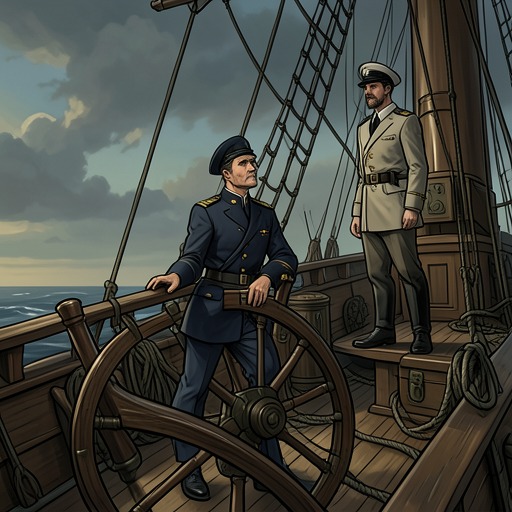
The shipboard episodes place these abstract standards against an everyday system of orders, surveillance, and punishment. Captain Queeg’s new rules are formally announced as shipwide requirements, yet the crew’s practical compliance follows what the narrative describes as a circle extending roughly as far as his eyes and ears. Within that sphere, new edicts are observed; elsewhere, the crew’s older habits persist. The contrast matters to the regulations’ concern with evidence: a commander’s authority is present throughout the ship, but the lived effect of his orders varies with his ability to monitor and enforce them.
A conspicuous example follows the USS Caine’s collision with a pier while docking. After the ship is secured, Captain Queeg orders two days’ leave taken from the entire crew, blaming the after line-handling party. Steve Maryk objects that the punishment is severe given the circumstances. Captain Queeg warns that further back talk will triple the penalty and extend it to the officers; Maryk then passes the order. The scene shows both the reach of command authority and the cost of challenging it. It does not, by itself, establish the legal grounds required by Articles 184–186, but it helps explain the tensions under which later judgments about command are made.
The same separation between official command and practical conduct appears during the ship’s water crisis. As oppressive conditions continue, members of the engine-room crew secretly draw water from the evaporators, and the news spreads through the ship. Paynter discovers what is happening and reports it to Maryk, who does not intervene. The officers know about the practice, but do not join the sailors below. This episode reveals an informal order operating alongside the captain’s rules; it also shows why a record of commands alone may not capture how authority is functioning aboard ship.
During the search for the missing item, Captain Queeg insists that every part of the ship be searched. Steve Maryk continues the search, but the crew’s effort slackens as the captain’s absence and the executive officer’s perfunctory manner become apparent. By midday, the search has become a farce, and Maryk halts it after accepting reports from his subordinates. Captain Queeg later treats the failure to find the item as confirmation that he had correctly judged his subordinates’ loyalty. The episode brings the competing accounts into view: one stresses obedience and loyalty, while the other shows an order losing practical force even as it remains formally in place.
The Articles in the Courtroom
At trial, the dispute over command fitness crosses between legal judgment and psychiatric opinion. Greenwald questions Dr. Forrest Lundeen about Captain Queeg’s behavior, gathering descriptions that include rigidity, feelings of persecution, unreasonable suspicion, withdrawal from reality, perfectionist anxiety, an unrealistic premise, and self-righteousness. When Greenwald recites that cluster, Dr. Forrest Lundeen characterizes the symptoms as mild and compensated. The exchange distinguishes identifying traits from proving that they disable an officer from command.
Greenwald presses Dr. Bird on a related distinction. Dr. Bird has accepted that Captain Queeg is disturbed and that the term bears a rough resemblance to sick, but cautions that the word sick applies broadly. Greenwald narrows the issue to the commander’s fitness and challenges the inference that being disturbed is compatible with command. Later, he argues that Dr. Bird has acknowledged sickness but does not consider Captain Queeg disabled, and questions whether a medical judgment can settle the distinct requirements of naval command. The testimony does not erase the difference between diagnosis and legal responsibility; it makes that difference part of the case.
The courtroom also returns to the regulations’ emphasis on the actual circumstances requiring action. Greenwald asks Captain Queeg whether, on the morning of December 18, when he was relieved, the USS Caine was in the last extremity. Captain Queeg answers that it was not. That answer is his testimony, not a complete resolution of the court’s inquiry, but it puts the decisive threshold into plain words. The regulations make the legality of relief depend not merely on a commander’s defects or a subordinate’s alarm, but on whether the facts made retaining command an intolerable danger and whether immediate referral was impracticable.
Narrative and Legal Significance
The rules appear before the story proper, placing the final dispute under a legal framework from the outset. The account acknowledges that the episode was not a mutiny in the old-fashioned image of armed sailors overthrowing a captain; nevertheless, a court of inquiry recommends a mutiny trial, and the episode becomes known throughout the service as the Caine mutiny. Articles 184–186 clarify why that label does not settle the issue. The story’s central question is whether an act that breaks the ordinary chain of command can be justified as a necessary response to extraordinary danger.
Together, the three articles hold two principles in tension. Subordinates must not treat private judgment as a license to displace a superior, yet military character includes the capacity for fearless initiative when circumstances demand it. The safeguards—lawful succession, inability to consult, exclusion of unknown orders as an explanation, investigation, substantial evidence, and accountability—make relief both possible and costly. In the USS Caine’s case, the courtroom tests those safeguards against contested testimony, observed conduct, and judgments about command. The regulations provide no shortcut from suspicion to verdict; they require the decision and the evidence behind it to be examined together.